Showing posts with label school of digital marketing. Show all posts

Wednesday, 24 August 2016

Google's evolved logos.

School of digital marketing

Once upon a time, Google was one destination that you reached from one device: a desktop PC. These days, people interact with Google products across many different platforms, apps and devices—sometimes all in a single day. You expect Google to help you whenever and wherever you need it, whether it’s on your mobile phone, TV, watch, the dashboard in your car, and yes, even a desktop!
Google has introduced a new logo and identity family that reflects this reality and shows you when the Google magic is working for you, even on the tiniest screens. As you’ll see, they have taken the Google logo and branding, which were originally built for a single desktop browser page, and updated them for a world of seamless computing across an endless number of devices and different kinds of inputs (such as tap, type and talk).
It doesn’t simply tell you that you’re using Google, but also shows you how Google is working for you. For example, new elements like a colorful Google mic help you identify and interact with Google whether you’re talking, tapping or typing. Meanwhile, they are bidding adieu to the little blue “g” icon and replacing it with a four-color “G” that matches the logo.
Article  Credit: Googleblogspot

Google Adwords Turns 15: A Look Back At the Origins

School of digital marketing

Google AdWords Turns 15: A Look Back At The Origins Of A $60 Billion Business.
AdWords launched with 350 advertisers in 2000. Today, more than 1 million advertisers generate tens of billions in revenue for the company.
AdWords turns 15 this month. The official birthday is October 23, but Google is celebrating the milestone today. Google’s not much of a stickler for exact birthdays, though; the company marked AdWords’ 10th birthday on November 8, 2010.
AdWords indisputably changed the trajectory of online advertising with its self-serve keyword bidding system and propelled Google to become the multi-billion-dollar business that is now the cornerstone of the holding company Alphabet. In 2014, Google reported ad revenues totaling more than $62 billion.
The Launch of AdWords:
AdWords came out of a roughly month-long beta with about 350 advertisers in October 2000. With the launch, Larry Page, Google’s co-founder and CEO, said of the new ad product, “AdWords offers the most technologically advanced features available, enabling any advertiser to quickly design a flexible program that best fits its online marketing goals and budget.”
AdWords was actually Google’s second advertising program. The first, called Premium Sponsorships, launched just months before, in August 2000. A direct sales team sold the premium sponsorship ads on a CPM basis. The premium ads appeared in the top spot in the search results, while the AdWords ads ran in the right rail. In a matter of a few years, the AdWords self-serve system subsumed the premium program.
The Simple Days Of 20 Million Searches:
Not only did AdWords debut in a time when desktop reigned, Google was a significantly smaller engine then. In 2000, Google said users were conducting more than 20 million searches per day on google.com. Fifteen years later, the search engine handles more than three billion searches per day. More than half of those searches now come from mobile devices.
And of course now, advertisers can run campaigns on YouTube, the Google Display Network and Google’s mobile app network, AdMob, all through the AdWords interface. Google reported $16.8 billion in ad revenues across its platforms in Q3 2015, up 13 percent from the previous year. Google doesn’t break out how much of that ad revenue comes from search, but it’s a significant majority.
The Current Search Landscape: Yahoo-Google?
Overall, search advertising accounts for half of all internet ad spend in the US, which topped $27.5 billion in the first half of 2015, according to the IAB. That includes search ad spend on Bing and Yahoo, but Google maintains nearly 64 percent of search share on desktop and almost 90 percent of mobile in the US.
Bing achieved profitability last quarter, according to Microsoft, thanks in large part to Windows 10, but the search engine has very low market share on mobile. That’s where Yahoo hopes to make its mark with Gemini, though Yahoo is also now looking to Google (again) to supplement monetization on both mobile and desktop queries if regulators play along.
Challenging Display Environment:
While Google has managed to remain dominant in search, the company has faced mounting competition on the display side, in particular, with the shift to mobile and rise of both social app 
usage and investment in native display advertising. Facebook has overtaken Google in display revenue share, according to eMarketer. Facebook is expected to hold 25 percent share of display ad revenues in the US, compared to Google’s 13 percent share in 2015.
Transformative Changes: Google Shopping & Enhanced Campaigns
The two biggest changes to AdWords in recent years were the transition of product search to the paid version of Google Shopping in 2012 and the transition to Enhanced Campaigns in 2013, which effectively made mobile a must-do for advertisers. Product listing ads now make up a significant portion of retailers’ search spend on Google, and Goldman Sachs estimates roughly 20 percent of Google’s ad revenue now comes from mobile. (If you think I’ve overlooked a significant update, let me know on Twitter.)
In 15 years, Google has grown its AdWords advertiser base from the 350 that came along for the beta to more than one million. For more fun facts (the troubling manscaping trend notwithstanding), check out the infographic Google put together to commemorate AdWords’ 15th birthday below. Happy slightly belated birthday, AdWords.
Article Credit: Search Engine Land

Monday, 22 August 2016

Google EMD Update MAGIC OF EMD STOPS..

School of digital marketing

Google officially declared about Google EMD update. This was working very well for a lot of website owners who had their targeted keyword in their domain. For a long time, it was possible to rank in the TOP 5 with literally no page rank, backlinks, compared to non EMDs.
Its simple, Exact Match Domains are, in general, domain names that exactly match the keyword a website wants to compete for. For example, (will take my website’s example..lol ) if a website wants to rank for the term [seo training institutes in pune], an exact match domain would be [seotraininginstitutespune.co.in]. Actually for many years, people were taking a lot of benefit of it. But now google has come up very strongly on it and will not give the same weight-age it as it used to give it earlier.
And the most importat thing is that Google Knew this because it was filed way back somewhere around September 2003. Matt Cutts infact had given a hint how they were going to change the EMD game on March 2011.
Google will keep on attacking now…
Article by: Rohit Shelwante

Wednesday, 17 August 2016

Bounce rate and exit rate difference


 I have received many questions about two important metrics in Digital Marketing, Bounce Rate and Exit Rate. It seems there is a lot of confusion about differences between the two
 I will tell you what exactly the difference is:
Bounce Rate: It is the percentage of people who visited only a single page of your website and left it. That is called as Bounce. For Ex: XYZ comes on the website, visit the home page and leave the website from there without going on any other page. So he will be counted in Bounce. No matter how time did he wait. Even if he waits on the home page for 1 Hour, then also he will be counted in Bounce
Exit Rate: Exit rate is the percentage of the page from which the visitor left the website. For Ex: XYZ comes on the website, visits the home page, the goes on about us and then on Contact us. So in this case, Contact us page will be counted as EXIT Page reason being, the visitor left the website from the “Contact Us” Page
Also keep one thing in mind, as I said that the person who visits on the home page and leaves the website is counted in bounce, that page (Home page) is also counted in Exit Page.
Article by: Rohit Shelwante

China blocked Google products

School of digital marketing

This Update came on 10th November 2012 by NextWeb Reports that China has decided to block Google services. Currently, Google search, Gmail, Google Maps, Google Docs, Google Analytics, Google Drive, and other Google products are currently not working when trying to access them within China.The Last time when China had blocked google was in last Feb 2011. When anyone trying to access any of the Google services is being pointed to a dead IP address 59.24.3.173.
Its said that is happening because of the 18th Party Congress of the Communist Party of China. It is unclear if the block is temporary for the 18th Party Congress or if this is something that is more long term.
Article by: Rohit Shelwante

Monday, 1 August 2016

What is Fetch as Google in Webmaster Tool?

We all use Google Webmaster Tool in digital marketing, but have you ever thought of what is Fetch as Google in this tool and what is the use of it. Its very simple, Fetch as Google tool lets you see a page as Google search engine sees it. particularly used by technical people or you’re troubleshooting a page’s poor performance in search results. For example, if you use rich media files to display content, the page returned by the tool may not contain this content if Google can’t crawl it effectively. You can choose to fetch a page as Google’s regular web crawler sees it or, if you publish mobile content, as our mobile crawlers do.

A Meta Keyword Tag for News Articles only

No, it’s time for   news_keywords in digital marketing. Google has come up with a new Meta Tag.Basically the new meta tag essentially gives publishers some freedom to be more creative in their headlines and article copy. So this means this Meta tag can be used by news publishers. Below is what it will look like.
meta name=”news_keywords” content=”World Cup, T20, India vs Pakistan”
Content Publishers are limited to 10 news keywords seperated by commas. Google has also made it very clear that using the news_keywords meta tag isn’t a quick path to ranking better in Google News. It’s only one signal, and “high-quality reporting and interesting news content remain the strongest ways to put your newsroom’s work in front of Google News users.”

Friday, 15 July 2016

Facebook removing ads from its desktop Pages


School of Digital marketing
The trend of ad-free Facebook Pages continues. Facebook has started testing another redesign of its desktop Pages that omits the ads that normally appear on the right-hand side of the page.
The apparent certainty of Facebook removing ads from its desktop Pages might not be that massive a deal in digital marketing. For starters, even if Facebook does pull them from desktop Pages, it doesn’t mean it’ll pull them from its desktop home page or people’s profile pages. And ads on its desktop Pages may not bring in enough money to justify them crowding the page when Facebook might prefer to free up that room to make Pages even more of a hub for businesses, publishers and celebrities, as it’s doing with the mobile version of Pages.
Facebook seems to have four ideas in mind of how it wants to change the current look of its desktop Pages: separate the profile photo from the cover photo, move the navigation menu to the left side of the page, move the page information boxes to the right side and remove the right-side ads altogether.
Facebook’s desktop ad business remains a significant, if small, revenue stream, and the right-hand ads are the smallest part of that supplementary stream. In the first quarter of 2016, 18 percent of Facebook’s overall ad revenue came from its desktop ads. But Facebook is serving up fewer desktop ad impressions than it used to, and the likely majority of the ones it is serving are news feed ads, the company’s cross-device cash cow that rakes in more money per ad than the seemingly endangered desktop-only right-hand ads.
The trend of ad-free Facebook Pages continues. Facebook has started testing another redesign of its desktop Pages that omits the ads that normally appear on the right-hand side of the page.
The apparent certainty of Facebook removing ads from its desktop Pages might not be that massive a deal in digital marketing. For starters, even if Facebook does pull them from desktop Pages, it doesn’t mean it’ll pull them from its desktop home page or people’s profile pages. And ads on its desktop Pages may not bring in enough money to justify them crowding the page when Facebook might prefer to free up that room to make Pages even more of a hub for businesses, publishers and celebrities, as it’s doing with the mobile version of Pages.
Facebook seems to have four ideas in mind of how it wants to change the current look of its desktop Pages: separate the profile photo from the cover photo, move the navigation menu to the left side of the page, move the page information boxes to the right side and remove the right-side ads altogether.
Facebook’s desktop ad business remains a significant, if small, revenue stream, and the right-hand ads are the smallest part of that supplementary stream. In the first quarter of 2016, 18 percent of Facebook’s overall ad revenue came from its desktop ads. But Facebook is serving up fewer desktop ad impressions than it used to, and the likely majority of the ones it is serving are news feed ads, the company’s cross-device cash cow that rakes in more money per ad than the seemingly endangered desktop-only right-hand ads.

Tuesday, 12 July 2016

Frequently asked questions during SEO interview


School of Digital marketing
Here are top 40 Trending SEO Interview Questions of digital marketing, for fresher’s and experienced. Be with the latest SEO trends.

  1. What is the X-Robots tag?
  2. Is case important for meta tags?
  3. What is the refresh meta tag and why is it not recommended?
  4. What is an .htaccess file and how do you use it?
  5. How can you use user agent and IP location detection to improve UX?
  6. What is a robots.txt file?
  7. What is a rel canonical?
  8. What is noindex, nofollow?
  9. When do you use robotx.txt, a rel canonical and a noindex nofollow?
  10. How do you optimize a web page?
  11. What is 200 ok?
  12. Have you ever optimized in a different language?
  13. What is a hreflang tag?
  14. What are good links for SEO?
  15. How does blogging play a role in SEO?
  16. What is the difference between absolute and relative URLs?
  17. What are 404 errors?
  18. What is 301 and 302 redirect? When should you use each?
  19. Have you used Screaming Frog?
  20. How do you check rankings for SEO?
  21. Are you Google Analytics certified?
  22. How would you test to see how Google can see content on a page?
  23. What are directory structures and subdomains and how are they important for SEO?
  24. What is https, how do you switch to https and why is it important for SEO?
  25. What is different about getting a Google Local page ranked opposed to a normal HTML page?
  26. What would you do to get a page indexed quickly?
  27. What are your favorite SEO tools?
  28. What are some of your most successful SEO projects?
  29. What are all the manual penalties you can get in Google?
  30. Tell me about a penalty you have cleaned up?
  31. How do you write a reinclusion request?
  32. How would you handle a hacked website?
  33. What are all the algorithmic issues you have in Google?
  34. How do you optimize for Google video search?
  35. What do you specify in video markup?
  36. What do you show in a video sitemap?
  37. Can Google news crawl PDF files?
  38. Can Google news include audio or multimedia content?
  39. What are the most common page speed issues?
  40. Does Google require a Google news sitemap?

     Source: Search engine land

Saturday, 9 July 2016

General Limits for LinkedIn Groups

What are some of the general limits for LinkedIn Groups?
LinkedIn is a important social media platform in Digital Marketing. Various limits for LinkedIn Groups are listed below. We believe these limits can accommodate those with a wide variety of interests and yet still encourage quality group management and engagement.

Group limits for members:
  • How many groups can I own and/or manage at one time?
Answer => 30.
  • How many groups can I be a member of at one time?
Answer => 100.
Note: Once you reach 100, you would need to withdraw from one before you’d be able to request to join a new group.
  • How many groups can I be a moderator of at one time?
Answer => 50.
  • How many mentions can I use in one conversation?
Answer => 20.

Group limits per group:
  • How many owners can a group have?
Answer => 1.
  • How many managers can a group have?
Answer => 10.
  • How many moderators can be in a given group?
Answer => 50.
  • How many members can be in a given group?
Answer => 20,000.

Why Link Farming is Bad for SEO?

The process of exchanging reciprocal links with Web sites in order to increase search engine optimization  in digital marketing. The idea behind link farming is to increase the number of sites that link to yours.
In theory, the more sites that link to yours, the higher your ranking in the search engine results will be because the more links indicate a higher level of popularity among users of the Internet.
However, search engines such as Google consider link farming as a form of spam and have been implementing procedures to banish sites that participate in link farming, so the term link farming has garnered negative connotations across the Internet.
Link farms were originated in response to Google’s ranking algorithm, PageRank. PageRank thinks of links as votes, where a page linking to another page is casting a vote. Therefore, pages with the most links were deemed valuable. Link farms were created to help increase PageRank, however, in recent times, Google and other search engines have adapted their algorithms to prevent link farms from appearing at the top of search engine results pages (SERPs).
Web sites that have created link farms can be penalized by Google and other search engines.
Link farming is considered a “black hat” method of search engine optimization (SEO) because the content on the web sites linking to each other is often not related, not created by a human (it can be created using programs or services) and is often of a very low quality. Search engines can detect link farms easily and they shouldn’t be seen as a legitimate long-term search optimization strategy.

Google Warns Site Owners for their Site

A month before the Google mobile-friendly algorithm boost, Google starts issuing new warnings to site owners.
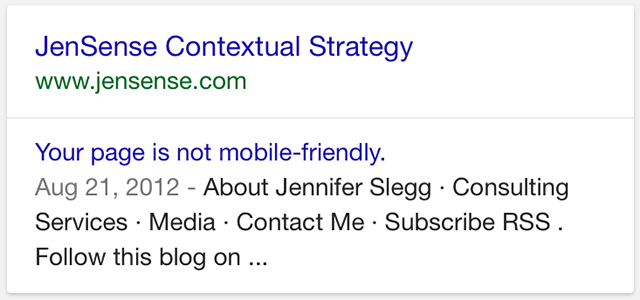
Google is now issuing a new type of warning to site owners if their site is not mobile-friendly. The new warnings show directly in the mobile search results, but only to the site owner, when Google knows that the searcher is the owner of the site.
Jennifer Slegg has an old site that is not mobile-friendly, and she reported that when she views the site in the mobile search results, it says to her in the snippet, “Your page is not mobile-friendly.” That message is a hyperlink to a Google help page about mobile-friendly.
Here is what Jenn sees as the site owner of a non-mobile-friendly website:
Here is what anyone else would see for this site — no warning:

A beautiful Cockroach theory speech by Sundar Pichai

Sundar Pichai – an IIT-MIT Alumnus and Global Head Google Chrome:
The cockroach theory for self development
At a restaurant, a cockroach suddenly flew from somewhere and sat on a lady.
She started screaming out of fear.
With a panic stricken face and trembling voice, she started jumping, with both her hands desperately trying to get rid of the cockroach.
Her reaction was contagious, as everyone in her group also got panicky.
The lady finally managed to push the cockroach away but …it landed on another lady in the group.
Now, it was the turn of the other lady in the group to continue the drama.
The waiter rushed forward to their rescue.
In the relay of throwing, the cockroach next fell upon the waiter.
The waiter stood firm, composed himself and observed the behavior of the cockroach on his shirt.
When he was confident enough, he grabbed it with his fingers and threw it out of the restaurant.
Sipping my coffee and watching the amusement, the antenna of my mind picked up a few thoughts and started wondering, was the cockroach responsible for their histrionic behavior?
If so, then why was the waiter not disturbed?
He handled it near to perfection, without any chaos.
It is not the cockroach, but the inability of those people to handle the disturbance caused by the cockroach, that disturbed the ladies.
I realized that, it is not the shouting of my father or my boss or my wife that disturbs me, but it’s my inability to handle the disturbances caused by their shouting that disturbs me.

Tuesday, 28 June 2016

Best rules for choosing perfect domain for SEO ranking

  • Make it Easy to Type
    If a domain name requires considerable attention to type correctly, due to spelling, length or the use of un-memorable words or sounds, you’ve lost a good portion of your branding and marketing value.

  • Make it Easy to Remember
    Remember that word-of-mouth and SERPs dominance marketing (where your domain consistently comes up for industry-related searches) both rely on the ease with which the domain can be called to mind. You don’t want to be the company with the terrific website that no one can ever remember to tell their friends about because they can’t remember the domain name.

  • Keep the Name as Short as Possible
    Short names are easy to type and easy to remember (see the previous two rules). They also allow for more characters in the URL in the SERPs and a better fit on social networks, print media, and every form of offline marketing (including the essential Word-of-Mouth).

  • Create and Fulfill Expectations
    When someone hears about your domain name for the first time, they should be able to instantly and accurately guess at the type of content that might be found there.

  • Your Site’s Name Should Not Violates Anyone’s Trademark
    This is a mistake that isn’t made too often, but can kill a great domain and a great company when it does. To be  sure you’re not infringing on anyone’s trademark with your site’s name.

  • Brainstorm 5 Top Keywords
     In Digital marketing, when you first begin your domain name search, it helps to have a small set of terms or phrases in mind that best describe the domain you’re seeking. Once you have this list, you can start to pair them or add prefixes & suffixes to create good domain ideas.

  • Make the Domain Unique
    Having your website confused with a popular site already owned by someone else is a recipe for disaster. Thus, I never choose domains that are simply the plural, hyphenated or misspelled version of an already established domain.

Top trending strategies as to when to adopt social platform

 Digital marketing, social media fails were just one of the many topics that Marketing Land’s Tim Peterson discussed with the panel, which also included Karianne Stinson, Marketing Manager at Microsoft, and Ef Rodriguez, HTC’s Director of Global Social. Below is a collection of some of the great quotes and takeaways on a variety of hot-button social media topics that the panel covered during today’s keynote.
School of Digital marketing

1) Instagram ads

Karianne Stinson, Microsoft: “You have to think of Instagram as an awareness platform, top of the funnel. If you’re expecting people to buy from Instagram, I don’t think we’re there yet. I don’t think people on Instagram are gonna buy a Surface or a smartphone (from an Instagram ad).”
Ef Rodriquez, HTC: “We don’t do much with Instagram ads because it doesn’t offer the targeting we need. I need hard working, click-based CTAs and I can get that better on Facebook.”

2) Role of social media

Caitlin Angeloff, Docusign: “When you think of all the functions of social media, you think about the customer lifecycle. Sales is one part of that, but social media plays a part in every stage of the customer lifecycle.”
Paul Meyers, Pabst: “We don’t do billboards. We don’t do traditional TV spots. Social media is where we talk to consumers. One of our brands is Not Your Father’s Root Beer. There was a lot of consumer demand for us to launch that in people’s hometowns, but we’re limited in what we’re allowed to say about availability. So we had to wait for retailers and consumers to spread the word about when it was available in their area.”

3) Snapchat

Angeloff: “We’re testing Snapchat. Consumers have started to notice that we’re there. We have one staffer, Laurel, who’s learning it and training our team, and when that platform is proven, we’ll take it our more widely to our company. If we can prove that a channel works, we can fight for more headcount. We can say, this channel is more time-consuming, we need a dedicated person. Snapchat is very different — you can’t repurpose content for that channel.”

4) Social video

Rodriguez: “Everyone has a video offering — even companies who shouldn’t have one have a video offering. People want video content. The fact that there are YouTube stars making a career out of YouTube is proof of that. I can’t say enough about video; none of us should be able to say enough about video because there’s so much out there.”
Stinson: “I like video, but I hope we don’t go to all video. We still need a mix — video isn’t right for every story every time. It’s still going to be a big push and it’s the gateway to VR/AR and that’s going to get bigger.”
Meyers: “For 360 video, it’s important that you captivate your audience. If you’re just toying with 360, make sure that you’re really interested. I think there’s going to be a lot of terrible brand video produced in VR.”
Stinson: “Our first XBOX Facebook Live video was just Major Nelson talking. It doesn’t have to be highly produced; it’s just people talking in the moment.”
Angeloff: “Don’t treat live video any different than other video you create. Have a storyboard, think about the experience that you want your live video to look like.”

5) Trendjacking

Stinson: “There’s so much risk with it. I think it has to have something to do with your brand. Like, I saw so many brands jumping on National Donut Day recently, but you have to be really selective because it can make you look really uncool.”
Rodriguez: “We’re a hardware manufacturer based in Taiwan; we can’t lose sight of that. We know we’re not well known in the USA. People don’t know what our initials stand for. We don’t have a Super Bowl budget. We’re not super fresh, and we don’t have street cred or skate cred like Vans. So not all of the trends happening on Twitter are appropriate for us. [If you trendjack], don’t lose sight of how this is going to come across to someone who’s not going to give you the benefit of the doubt.”
Angeloff: “I see times when brands should be part of the conversation, but a lot of times it looks like they’re elbowing their way into the dinner table. For example, Microsoft and LinkedIn are both customers of ours and both are huge users of Docusign’s product. Had we been a little more nimble, I would’ve encouraged us to go out and ride that wave of conversation [when the acquisition was announced]. We have multiple areas where we would’ve been relevant and we could’ve trendjacked. Would it have been successful? I don’t know, but the data would’ve told us.”

6) Adopting new social channels

Stinson: “I signed up for Ello. I signed up for Peach. But I didn’t sign up my brands for those. If you’re in this room, you need to be on Snapchat at least personally. Our executives look to us to answer when they ask things like, Should we be on Snapchat?”
Meyers: “We weren’t on Snapchat when it first came out because it was really weird. We’re primarily using Snapchat now with geofilters around 21-and-over venues.”
Angeloff: “Snapchat is an emerging channel. We’d have to get way more adoption to say it’s worthy of continued investment. When we put a URL in a snapchat story, we do see a spike of traffic. The biggest thing is the toolsets — we don’t have to decide when something’s proven, it’s when the platform opens up an API and the toolsets can begin to support them.”
Meyers: “I put Old Milwaukee on Tinder three years ago. In Austin, there are three bars that sell Old Milwaukee. I put the beer on Tinder as a female interested in males and the account directed the guys to the three bars. Tinder shut that down in about an hour.”
When it comes to social media #fails, brands have to expect the worst. “Mistakes will happen even if you have protocols in place,” said Caitlin Angeloff, Head of Global Social Strategy and Operations at Docusign, during today’s Brands Talk Social Media keynote at Marketing Land’s Social Pro conference. Paul Meyers, the Director of Digital Marketing for Pabst Brewing, echoed that sentiment when he told the audience that some mistakes are bound to happen. “We have a process in place, but my team is five people and we’re dealing with 30 accounts that we manage.”

Source: Search engine land